Early intervention physiotherapy for rural workplaces
Workplace health & early intervention
Why early intervention physiotherapy is the smartest investment rural Australian workplaces can make in 2026
James Combes - Director & Head Physiotherapist, Telephysio Australia
WorkCover prevention Telehealth physio Rural workplaces
If you run a business in regional or remote Australia, whether that's a mine site in the Pilbara, a construction crew in outback Queensland, an agricultural operation in the Riverina, or a manufacturing plant in rural Victoria, you already know that getting a worker in front of a physiotherapist quickly is no small feat. The nearest clinic might be an hour away, appointment wait times can stretch weeks, and in the meantime a minor muscle strain quietly turns into a full WorkCover claim.
That's the exact problem Telephysio Australia exists to solve: same-day telehealth physiotherapy assessment and early intervention, anywhere in Australia, via a secure video call. In this post we break down the real cost of delayed treatment, the evidence behind early intervention, and how online physiotherapy is changing workplace injury management for good.
The true cost of musculoskeletal injuries in Australian workplaces
Musculoskeletal injuries, back pain, shoulder strains, tendinopathy, knee injuries, repetitive strain, are by far the most common and costly work-related injuries in Australia. According to Safe Work Australia, serious workers' compensation claims have risen by 34.5% over the past decade, with musculoskeletal disorders accounting for close to 90% of all serious workplace injury claims nationally.
$65,000 - Average cost per serious musculoskeletal WorkCover claim (Safe Work NSW, 2018–2023)
$55B+ - Annual cost of work-related musculoskeletal disorders to the Australian economy (Deloitte Access Economics)
7.4 weeks - Median time off work per serious compensation claim (Safe Work Australia, 2024)
4x longer - Duration of disability when physio starts after 30 days vs. within 7 days (Mekonnen et al., 2025)
And those numbers are just the direct costs. When you factor in lost productivity, overtime for replacement labour, the administrative burden of managing a WorkCover claim, and the long-term impact on workplace culture and morale, the real cost of a single serious injury can easily exceed $100,000.
For rural and regional operations, the risk is compounded by geography. When the nearest physiotherapy clinic is 60–90 minutes away, workers delay seeking care. New Australian research confirms just how devastating that delay can be.
Key research
Relationship between the timing of physical therapy commencement and the duration of work disability: a retrospective cohort analysis of work-related low back pain claims
Mekonnen TH, Sheehan LR, Di Donato M, Collie A, Russell G. BMC Public Health. 2025;25:1329.
Analysed 9,160 accepted workers' compensation claims for low back pain across two Australian states. The study found a direct, dose-response relationship between how long workers waited to see a physiotherapist and how long they stayed off work.
The findings are stark. Workers who commenced physiotherapy within 7 days of injury had a median work disability duration of 8.0 weeks. Workers who didn't start physio until more than 30 days after injury had a median disability duration of 34.7 weeks, more than four times as long. Same injury, completely different outcome, driven almost entirely by how quickly they accessed care.
8.0 weeks - Physio within 7 days
~17 weeks - Physio at 8–14 days
34.7 weeks - Physio after 30 days
Median work disability duration by timing of physiotherapy commencement. Source: Mekonnen et al., BMC Public Health, 2025.
The study also found that compared to starting physio within 7 days, waiting 8–14 days was associated with a 37% increased likelihood of prolonged disability. Waiting 15–30 days increased that likelihood by 119%. Waiting more than 30 days was associated with a 315% increased likelihood of longer disability duration. This is a dose-response relationship: every week of delay compounds the harm.
Key insight: For rural and regional workplaces where the nearest physiotherapy clinic is an hour away, workers commonly wait 2–4 weeks before seeing a physio — a delay that, according to this Australian research, is associated with disability lasting months rather than weeks. Telehealth physiotherapy eliminates that delay entirely.
What is early intervention physiotherapy and why does it work?
Early intervention physiotherapy means connecting an injured worker with a qualified physiotherapist as soon as possible after a musculoskeletal injury occurs, before the pain becomes chronic, before the worker develops fear-avoidance behaviours, and before the injury escalates into a formal WorkCover claim.
An early physiotherapy assessment does several important things:
Accurate diagnosis: The physiotherapist identifies the exact nature of the injury through thorough subjective questioning and objective physical testing even via video so the worker receives targeted, appropriate treatment from day one.
Education and self-management: Workers who understand their injury and what to do about it recover faster. Clear advice about activity modification, return-to-work strategies, and red flags to watch for dramatically improves outcomes.
Targeted exercise prescription: A personalised home exercise program prescribed in the first week of injury accelerates recovery, maintains function, and prevents the deconditioning that turns acute injuries into long-term disability.
WorkCover claim prevention: When workers are assessed, reassured, and actively managing their recovery, the rate of formal compensation claims drops significantly. Early intervention is the most cost-effective injury management tool available to Australian employers.
Return-to-work planning: Modified duties and graded return-to-work plans keep workers engaged, preserve income, and avoid the well-documented negative health effects of long-term absence from work.
"Telehealth consistently produced health outcomes akin to in-person care. In all but one study, telehealth was less costly, with savings achieved by reducing in-person consultations and travel costs."
Marks, D., et al. (2022). The Health Economic Impact of Musculoskeletal Physiotherapy Delivered by Telehealth. International Journal of Telerehabilitation.
The rural workplace physio access problem
Rural and regional Australian workers face a physiotherapy access crisis that simply does not exist in major cities. The Australian Institute of Health and Welfare consistently reports that allied health services, including physiotherapy, are severely under-resourced outside metropolitan areas. For businesses operating in mining, construction, agriculture, and manufacturing in these regions, the practical consequences are stark.
Workers injure themselves on a Monday. The nearest physiotherapy clinic is 90 minutes away and has no appointment until Thursday. By Thursday, the worker has rested for four days without guidance, the injury has stiffened up, they're anxious about what's wrong, and they've already spoken to a WorkCover lawyer. Research by Mekonnen and colleagues confirms that even this modest delay, starting physio at 8 to 14 days rather than within the first week, is associated with a 37% increased likelihood of prolonged disability. A claim that could have been resolved in two months now has a realistic timeline of six months or more.
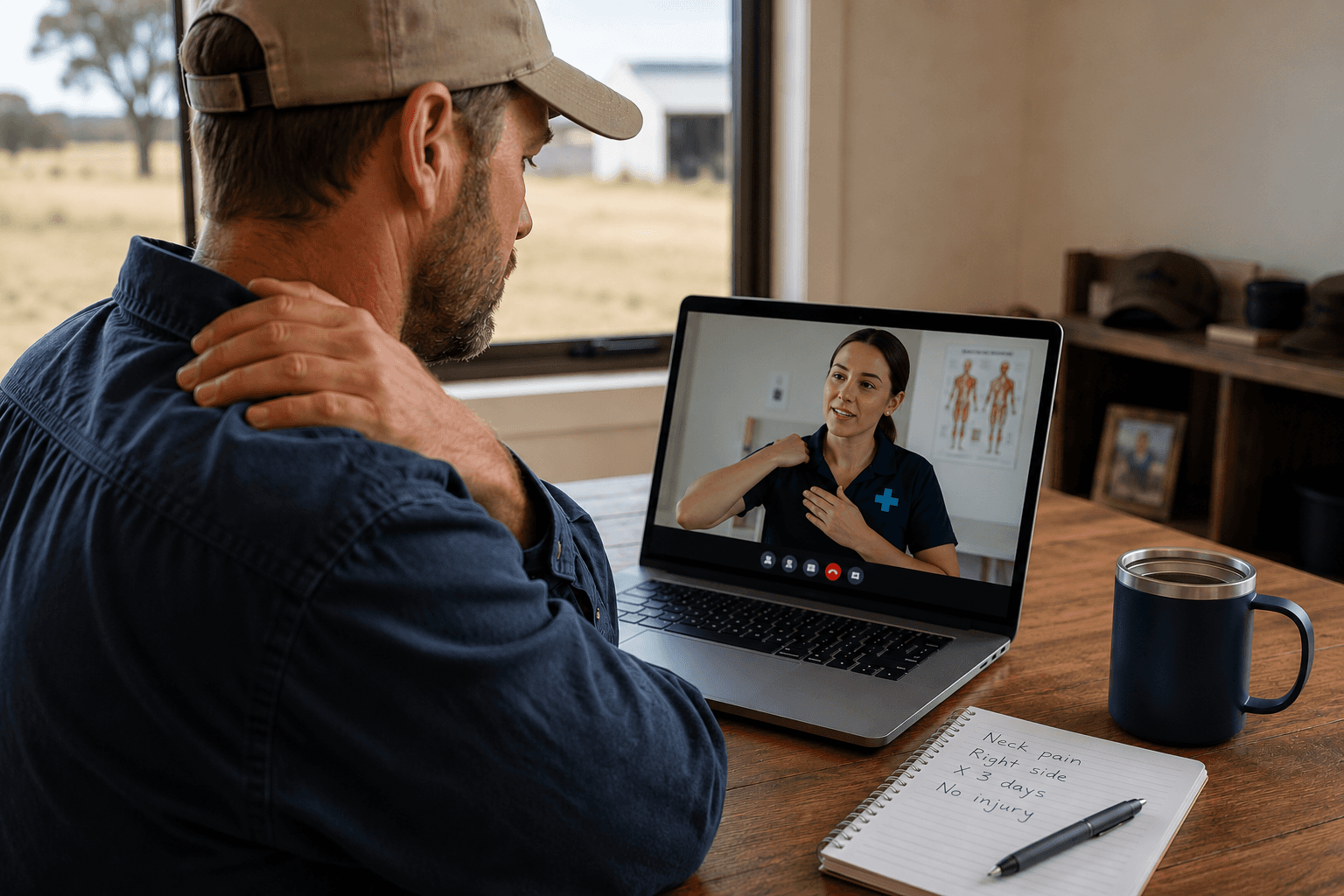
Telehealth physiotherapy eliminates this problem entirely. With Telephysio Australia, a worker can be assessed by a qualified AHPRA-registered physiotherapist via a secure video call on the same day they're injured, whether they're in Broken Hill, Karratha, Mount Isa, Mildura, or anywhere else across Australia.
Industries we serve across rural and regional Australia
⛏ Mining & resources: Remote site workers, FIFO operations, manual handling injuries
🏭 Manufacturing: Repetitive strain, back injuries, shoulder and upper limb conditions
🏗 Construction: Musculoskeletal injuries, knee pain, sprains and strains
🌾 Agriculture: Seasonal workers, physical labour injuries, tendinopathy
Our ideal workplace client operates in a rural or regional area with limited local allied health access, and works in an industry with a high risk of musculoskeletal injury. If you're currently self-insured or want to actively manage your WorkCover premium, early intervention physiotherapy is one of the highest-return investments available to you.
How Telephysio Australia's workplace early intervention program works
Telephysio Australia's workplace early intervention service is designed to be fast, simple, and seamless for both employers and workers. Here's how it works in practice:
A worker is injured or reports pain: The manager contacts Telephysio Australia and we arrange a same-day or next-day telehealth physiotherapy assessment. No travel required. No waiting rooms. No delays.
Video consultation with an AHPRA-registered physiotherapist: The worker connects via a secure video platform from their phone, tablet, or computer. Our physiotherapists conduct a thorough assessment, including subjective history and guided physical examination, equivalent in quality to an in-person review.
Diagnosis, education, and exercise prescription: The worker receives an accurate diagnosis, practical education about their condition, and a tailored home exercise program. They leave the consultation with a clear plan and realistic expectations for recovery.
Return-to-work and modified duties planning: Where appropriate, we work with the employer to develop modified duties that keep the worker productive while they recover, significantly reducing time off work and WorkCover liability.
Ongoing management and follow-up: Subsequent telehealth consultations monitor progress, adjust the treatment plan, and ensure the worker is on track for full recovery and safe return to full duties.
"Remotely delivered physiotherapy with support via phone, text and an app is as good as face-to-face physiotherapy for the management of musculoskeletal conditions."
Withers, H.G., et al. (2024). REFORM randomised trial. Journal of Physiotherapy, 70(2), 124–133.
The evidence base: is telehealth physiotherapy as effective as in-person care?
This is the most common question we receive from operations managers and WHS professionals considering telehealth physiotherapy for the first time. The short answer, backed by a substantial and growing body of peer-reviewed research: yes.
A 2024 randomised controlled trial published in the Journal of Physiotherapy found that remotely delivered physiotherapy produced outcomes equivalent to face-to-face physiotherapy for musculoskeletal conditions. A systematic review published in the International Journal of Telerehabilitation found that telehealth physiotherapy consistently produced health outcomes comparable to in-person care, and in most cases was less costly, with savings achieved through reduced travel and fewer in-person consultations.
For rural populations specifically, research reports a remarkably high patient satisfaction rate with telehealth as a model for delivering physiotherapy and related services. The technology works. The evidence is strong. The gap between knowing this and acting on it is where most rural businesses are losing money right now.
Telephysio Australia's research page at telephysioaus.com/research compiles the current peer-reviewed evidence across general musculoskeletal conditions, lower back pain, knee injuries, shoulder conditions, neck pain, and more.
WorkCover and MBS Medicare billing: understanding your options
For workplace early intervention (employer-funded)
Employers can arrange early intervention consultations directly with Telephysio Australia as a proactive investment in injury prevention and WorkCover cost reduction. The Mekonnen et al. (2025) research makes the case clearly: getting a physio involved within the first week of injury is associated with disability lasting around 8 weeks. Waiting more than a month is associated with disability lasting nearly 9 months. A single avoided WorkCover claim typically saves far more than an entire year's worth of early intervention consultations.
For patients on Medicare chronic care plans (no gap fee)
Telephysio Australia provides bulk-billed, gap-free physiotherapy for patients on GP Management Plans (GPMP), Team Care Arrangements (TCA), and Enhanced Primary Care (EPC) chronic care plans, the Medicare items commonly known as GPCC plans. Patients in rural and regional areas who have been referred by their GP for physiotherapy under one of these plans pay nothing out of pocket.
For WorkCover and CTP claims
Telephysio Australia also provides physiotherapy services for workers who have already lodged a WorkCover or CTP insurance claim, supporting ongoing management and recovery.
Frequently asked questions about telehealth workplace physiotherapy
Can a physiotherapist really assess a workplace injury properly over video?
Yes. The research consistently shows that telehealth physiotherapy assessment of musculoskeletal conditions, including workplace injuries, produces diagnostic accuracy and treatment outcomes equivalent to in-person care. Our physiotherapists are trained in telehealth assessment and guide workers through relevant physical tests during the consultation.
How quickly can an injured worker be assessed?
In most cases, same-day or next-business-day. This is the critical advantage of telehealth early intervention, no waiting for the next available in-person appointment, no travel time, and no delay in getting appropriate clinical guidance to the injured worker. Given that Australian research shows delays beyond 7 days are associated with significantly longer disability, speed of access is everything.
What technology does the worker need?
Just a smartphone, tablet, or computer with a camera and internet connection. Our platform is simple and accessible, workers in rural and regional Australia use it comfortably every day, including on mine sites, farm properties, and construction sites with standard mobile connectivity.
Does early intervention physio actually reduce WorkCover claims?
The evidence strongly supports this. A 2026 Australian study of 9,160 WorkCover claims found that workers who started physiotherapy within 7 days of injury had a median disability duration of 8 weeks, compared to 34.7 weeks for those who waited more than 30 days. Workers who receive early physiotherapy assessment and guidance are significantly more likely to recover quickly, maintain confidence in returning to work, and avoid the chronic pain and psychosocial factors that drive long-term WorkCover claims.
Is Telephysio Australia available to businesses outside of major cities?
Yes, this is exactly who we built the service for. Telephysio Australia provides telehealth physiotherapy across the entire country, including remote and very remote areas. All of our physiotherapists are AHPRA registered and experienced in managing the types of musculoskeletal injuries common in rural and regional workplaces.
Take action before the next injury becomes a WorkCover claim
The cost of workplace musculoskeletal injuries in rural Australia is not inevitable. It is largely preventable, and when injuries do occur, their trajectory is dramatically influenced by how quickly appropriate care is provided. Australian research now makes this undeniable: workers who access physiotherapy within the first week of a work-related back injury have disability lasting around 8 weeks. Workers who wait more than a month face disability lasting nearly 9 months.
Telehealth physiotherapy through Telephysio Australia gives rural and regional businesses the tool they've been missing: fast, expert, evidence-based physiotherapy assessment and early intervention, available anywhere in Australia from the moment an injury occurs.
If your business operates in mining, construction, agriculture, or manufacturing, and you want to reduce your WorkCover exposure, protect your workers, and build a workplace health strategy that actually works in a regional context, we'd love to talk.
Get early intervention working for your workforce
Same-day telehealth physio assessment, anywhere in Australia. No travel. No waiting. Evidence-based care that prevents WorkCover claims before they start.
Book a consultation at telephysioaus.com
References
Mekonnen TH, Sheehan LR, Di Donato M, Collie A, Russell G. Relationship between the timing of physical therapy commencement and the duration of work disability: a retrospective cohort analysis of work-related low back pain claims. BMC Public Health. 2025;25:1329. doi: 10.1186/s12889-025-22574-x
Withers HG, et al. Remotely delivered physiotherapy is as effective as face-to-face physiotherapy for musculoskeletal conditions (REFORM): a randomised trial. Journal of Physiotherapy. 2024;70(2):124–133.
Marks D, et al. The Health Economic Impact of Musculoskeletal Physiotherapy Delivered by Telehealth: A Systematic Review. International Journal of Telerehabilitation. 2022;14(2):e6524.
Harkey LC, et al. Patient satisfaction with telehealth in rural settings: A systematic review. International Journal of Telerehabilitation. 2020;12(2):53–64.
All Telephysio Australia physiotherapists are registered with the Australian Health Practitioner Regulation Agency (AHPRA). Follow us on Instagram, Facebook, and LinkedIn @telephysioaus for workplace health tips and the latest telehealth physiotherapy research.